Golf Car-Type Vehicles of the Future
Among the many benefits in attending the annual PGA Shows is that one can get a strong impression as what golf car manufacturers are anticipating in the coming months and even years. The 2026 Show was certainly no exception. Here are the questions, the answers to which, Team SVR sought to research and evaluate:
• On the heels of the implementation of countervailing duties and anti-dumping penalties imposed by the U.S. international Trade Commission and the Department of Commerce, how were Chinese manufacturers likely to react?
• Given the grass roots surge in their use on public roads, how were manufacturers respond in terms of vehicle design and upgrades?
Shifts in the competitive framework
Show attendance by Chinese vehicle manufacturers and parts suppliers substantially surpassed this category in previous shows and reflected changes in the supply chain servicing the U.S. market. Because the penalties cited above relate to products of Chinese origin, a clear option for Chinese companies would be to move their manufacturing to other countries.
In interviews conducted booth by booth, SVR found that new factory/assembly operations were cropping up in Vietnam, Cambodia, and Thailand. Two companies had locations in Africa.
Recitations destined for the U.S.
In addition to countries and areas mentioned, the U.S. is also on the list of relocations. States involved are South Carolina, Tennessee, and Texas. According to individuals interviewed at the Show, these are full assembly operations, not just final assembly facilities.
Less competition, or more?
Paradoxically, if the intention of the AD/DVD penalties was to level the playing field for American manufacturers (and it was) and screen out Chinese companies and eliminate unfair competitive practices in general, the result is likely to be not less competition, but more. This seems to be the probable outcome of supply chain reshuffling that is presently going on.
From an industry dominated by three companies two decades ago and prior to that, it now seems destined for more intense competition with multiple companies participating. In recent years, of course, there have been a fair number of start-up companies emerging, but these companies were largely the beneficiaries of subsidized partial assemblies originating in China, with finished assembly taking place in the U.S.
While this particular paradigm may be ending, Chinese manufacturers are scrambling to find new supply chain logistics.
What to expect in the market over the next 3-5 years
In the next three-to-five years look for the market to see increased prices and expansion The new competitive framework will assure both. Increased prices will emerge, despite the more intense competition, because of upgrades, which may make the vehicles, on average, more costly, but also more attractive to the consumer.
Taking full advantage of the groundswell of street legal golf cars
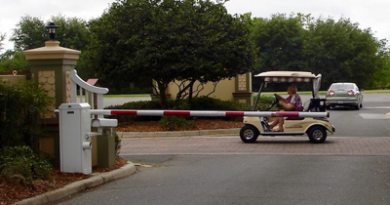
The groundswell of use of golf car-type vehicles (LSVs) on public roads continues. Virtually all States in the country allow golf cart-type vehicles on public roads, subject to various restrictions applying to both vehicle and driver (e.g., a driver’s licensed needed). A comprehensive survey of applicable laws across all 50 States of the Union may be found here: https://1800lionlaw.com/laws-for-driving-golf-carts-on-roads-in-the-us/#:~:text=Driving%20golf%20carts%20is%20allowed,Office%20of%20Motor%20Vehicle%20(OMV).
Although States provide the overall legal framework for LSV use on public roads, local community regulations largely prevail with regard to what streets can actually be accessed. This results in a myriad of conditions at a multiplicity of local jurisdiction. Despite these complexities, the use of LSVs as a viable and cost effective alternative to conventional automobiles and light trucks continues to grow and gain popularity.
Refinements and upgrade’s in LSVs themselves is, and will be, a key factor in market growth and local official acceptance. In the following we give examples of vehicle designs and capabilities that caught the eye of the SVR team at the recent PGA Show.
Upgrades of the type that will drive the market
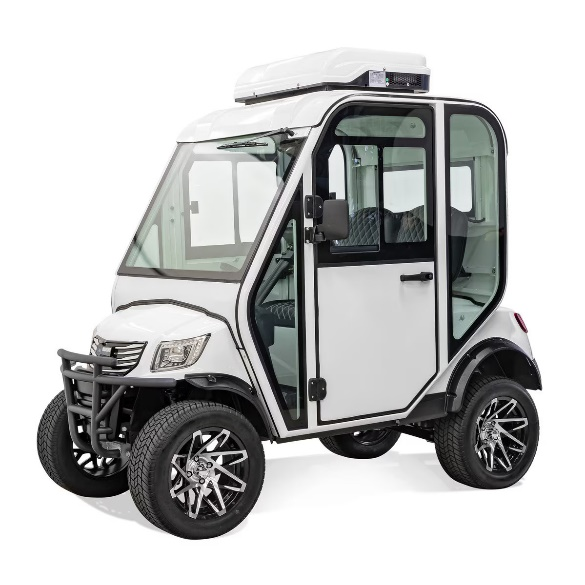
The first LSV that had standout features was from Massimo Motor, which is pictured below. The first thing to notice is that it is fully-enclosed with a hardshell canopy. The vehicle can be, thus, fully weatherized and suitable to year around used under all weather conditions.
The Massimo HVAC fully-enclosed LSV.
The model shown is the Massimo HVAC. Because of this weatherized design, a vehicle of this type can find additional markets particularly in cold weather regions. And, yes, it does rain in Florida, so the design will be welcome in fair weather States as well.
Addressing distance anxiety
The second vehicle that carries the promise of market expansion is the Gemini from Star EV. One of the outstanding features of this vehicle is under the hood in the form of a permanent magnet motor.
The Gemini from Star EV
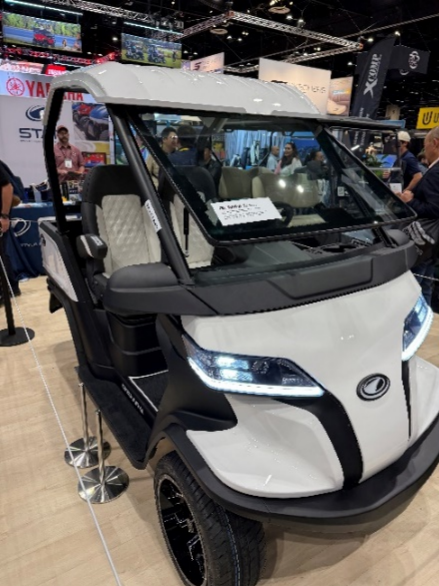
As described by Doug Ballenger, Star EV’s Executive Sales Director, the permanent magnet motor is the next iteration of electric motor engineering upgrade, just as the AC induction motor outperformed its predecessor, the DC motor, some years ago. The result is 15% more efficiency and greater distance and power performance. According to Ballenger, the vehicle has been tested for a distance capability of up to 90 miles.
In the model pictured, the seating is a traditional side-by-side, with a baggage area to the rear. While an open cockpit is shown, the cockpit can be fully enclosed with hard doors and roll-up windows. The upper body of the vehicle is constructed with door frames to accommodate secure, weather-tight doors.
The Gemini stands out as the next iteration in the development of street legal golf cars which will be fully weatherized for year around use.
Competetive dynamics will drive market gains
The competitive framework that is developing should work to accomplish the trends in upgrades, pricing, and market growth suggested above. In addition, the fact that market growth takes place at the local level translates into a strength because of the grass roots attraction.
Local development also suggests a diversity of outcomes, particularly with regard to the timing of market development, in that local jurisdictions and environments will play a key role.
Need for a national dealers association
The Low Speed Vehicle Dealers Association (LSVDA) is stepping in to deal with government policies on both the local and national levels. In so doing the LSVDA will be acting in the interests of both dealers and the public: For dealers a lobbying effort to expedite and extend LSV use on public roads, and for the public, to assure the highest standards of vehicular maintenance and safety, as well as promoting education for safe driving habits. www.lsvda.com
________
Contact the Author: Steve Metzger at smetzger@smallvehicleresource.com. Or check out our website at www.smallvehicleresource.com, where you will find an extensive database of vehicle models and can make side-by-side comparisons of vehicles based on a full set of specifications.