New LSVs Emerge in Context of the European Market and EU Vehicle Definitions
Europe seems well beyond the gated community here in the U.S., so why discuss developments in the European market? Here are three key reasons:
• Highlight the variety of small, electric vehicles that are available in the EU;
• Put emphasis on the flexibility of the regulatory regime which defines the categories of small, electric vehicles; and as a final note,
• Point out the advantages to market and product development that would be forthcoming in emulating the vehicle definitions found in the EU.
Major European automakers supply the small electric vehicle market—and there are startups
Unlike the U.S. where LSVs are upgraded derivative of golf carts and manufactured by companies that specialized in this type of vehicle, the European small electric vehicle is largely produced by major automakers, such as Fiat, Citroën, and Renault. These initiatives by large automakers were somewhat experimental, and some of the iconic models, such as the Twizy and Duo from Renault have been discontinued. Notable recent start-ups, Micro and Squad Mobility, however, continue t push ahead with their small vehicle concepts.
Mobilize Duo produced in two versions
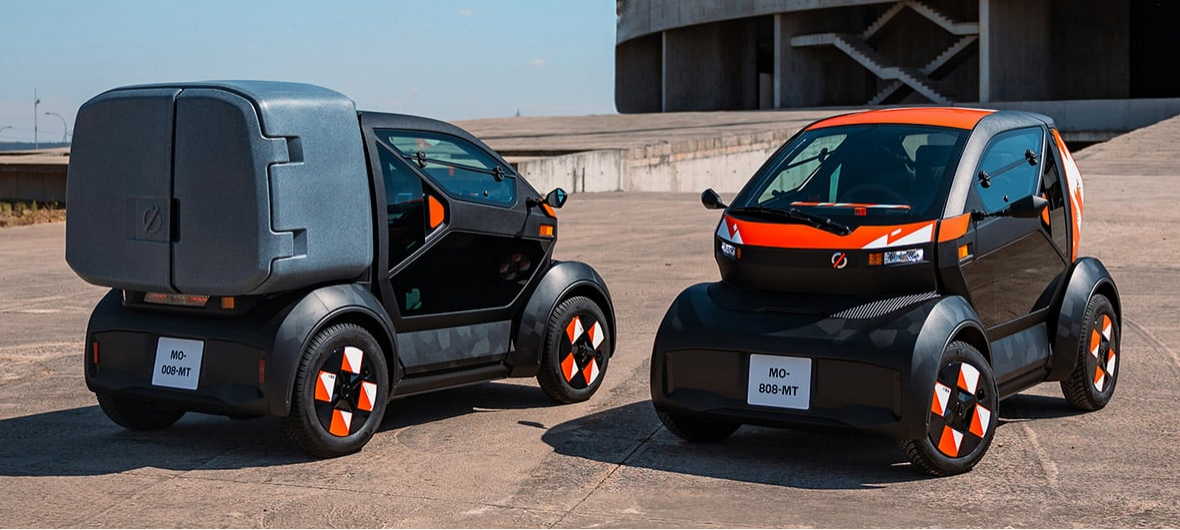
The Mobilize Dur came in two versions, taking advantage of the two variations in European quadricycle classifications.
• L6e (Light Quadricycle): Applies to the Duo 45 variant. This version has a limited top speed of 45 km/h (approx. 28 mph) and can be driven without a full driver’s license in many European countries (by individuals as young as 14 with an AM license).
• L7e (Heavy Quadricycle): Applies to the Duo 80 variant. This version can reach a top speed of 80 km/h (approx. 50 mph) and requires a standard B or B1 driver’s license.
Note the significant difference in top speed between the two classifications. In particular, the heavy quadricycle tops out at about 59 m.p.h., compared to the light quadricycle at just under 30 m.p.h. In Europe there are varying restrictions with regard to licensing.
Key safety features
While they face less stringent crash-testing regulations than full-sized cars, the Mobilize Duo stands out in its category by including a driver’s airbag and a built-in crumple zone. Such features might well be key upgrades in LSVs for the U.S. market and could pave the way to emulation of the European quadricycle standards.
Start-up developed in Europe may come to the U.S.: The Squad Mobility
Much like the Mobilize Duo, the Squad Solar City Car falls squarely into the electric quadricycle (or microcar) category. The vehicle is intended to be marketed on a global basis, and therefore, its exact legal classification depends on the region:
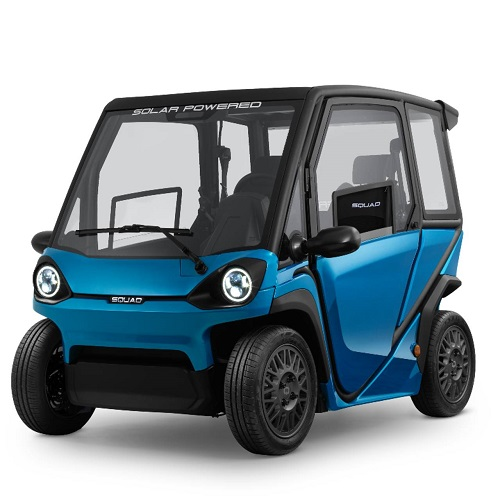
The Squad Mobility vehicle is a small solar-electric urban vehicle developed by the Dutch company in the Netherlands. It is marketed as the world’s first “Solar City Car” and is designed for short urban and suburban trips rather than highway driving.
What makes it different?
• Solar roof charging: The roof contains solar panels that can add roughly 20–30 km (12–19 miles) of range per day under favorable European conditions.
• Fully-enclosed: The fully-weatherized cabin makes to the vehicle suitable for travel in North American temperate climates, thus expanding the potential market across more than fair-weather regions.
• Compact size: About 2 meters (6.5 ft) long, allowing perpendicular “cross parking” and very efficient use of urban space.
• Electric drivetrain with good distance capabilities: Uses removable, swappable lithium-ion battery packs with a total range of up to about 100 km (62 miles), excluding solar charging.
• Low-speed urban use: The L6 version is limited to 45 km/h (28 mph), while a faster L7 version is planned at about 70 km/h (43 mph).
From a styling perspective, the Squad Mobility is a step away from the legacy golf cart design and closer to the off-road UTV designs. This could help in gaining acceptance from regulatory authorities, as UTVs have little or no regulations for street use, except at the local level.
Enclosed scooter, e-bike, or? The Microlino
The Microlino is made by Micro Mobility Systems (often just called Micro), a family-owned Swiss company. The name may sound familiar outside of the car world, it’s because Micro is the exact same company that invented and popularized the modern aluminum kick scooter back in the late 1990s!
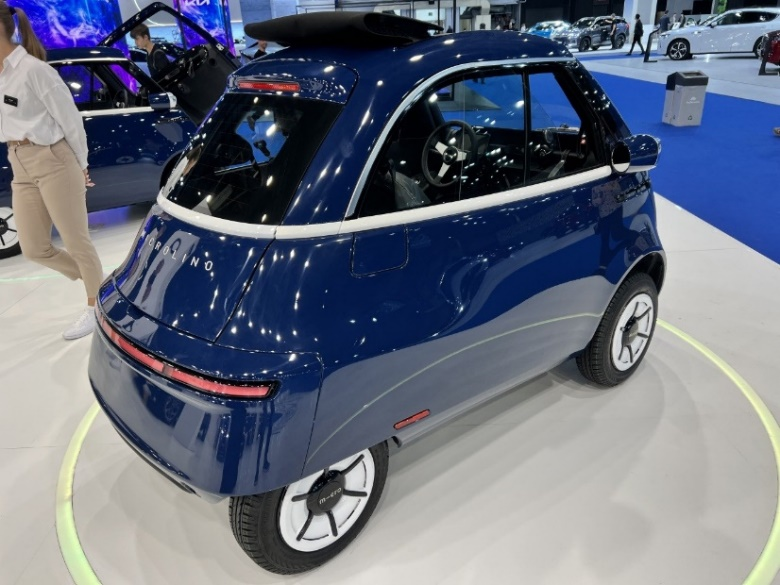
The Ouboter family, who founded the company, used the profits from their massive global scooter business to fund the development of the Microlino, aiming to bridge the gap between a motorcycle and a traditional car.
A few interesting details about its manufacturing:
• The Design & Engineering: While Micro is a Swiss company, the vehicle itself was engineered as a modern, electric homage to the classic 1950s BMW Isetta “bubble car.”
• The Factory: The Microlino is actually built in Turin, Italy. Micro established its own dedicated manufacturing facility there in partnership with CECOMP (an Italian automotive engineering company) to build the vehicles with a predominantly European supply chain.
A diversity of emobilty solutions from Europe
Americans have always thought of themselves as being innovators, ready to break the mold, while Europe was stodgy and unchanging. Certainly, with regard to e-mobility vehicles. that characterization does not hold. LSVs, the U.S. version of the European quadricycle, remains pretty much stuck in its golf cart legacy.
Not a small factor in the LSV-quadricycle difference in vehicle develop-ment is the difference in the regulatory regimes which govern the performance characteristics of small, electric vehicle models. Were NHSTA to recast current LSV regulations in the mode of the more flexible, overall less restrictive European classifications, we might well see an explosion of new small electric vehicle designs and a significant market expansion in the U.S.